BlockWorks
BlockWorks is a browser-based application for the kinematic and limit-equilibrium analysis of rock masses intersected by discontinuities, grounded in the Block Theory framework of Goodman and Shi (1985). The tool characterizes blocks formed by the intersection of joint sets and free surfaces in excavations such as rock slopes and surface cuts, providing a unified environment for assessing block geometry, removability, and stability.
The application comprises three complementary analytical modules:
- Removability Analysis — Employs stereographic projection to enumerate joint pyramid configurations and identify kinematically removable blocks according to Shi’s theorem.
- Three-Dimensional Block Visualization — Reconstructs the geometry of blocks bounded by intersecting discontinuity planes, enabling inspection of vertices, faces, and computed block volume.
- Stability Analysis — Performs limit-equilibrium evaluation of removable blocks, incorporating frictional resistance, applied force cases, and pseudo-dynamic loading.
The analytical algorithms derive from the foundational formulations of Prof. Richard E. Goodman and Dr. Gen-Hua Shi, reimplemented in a modern web architecture to make established Block Theory methods openly accessible for research, instruction, and engineering practice. The software can be accessed at this link.


Screenshots from BlockWorks User Interface
bimLab — Virtual Bimrock Laboratory
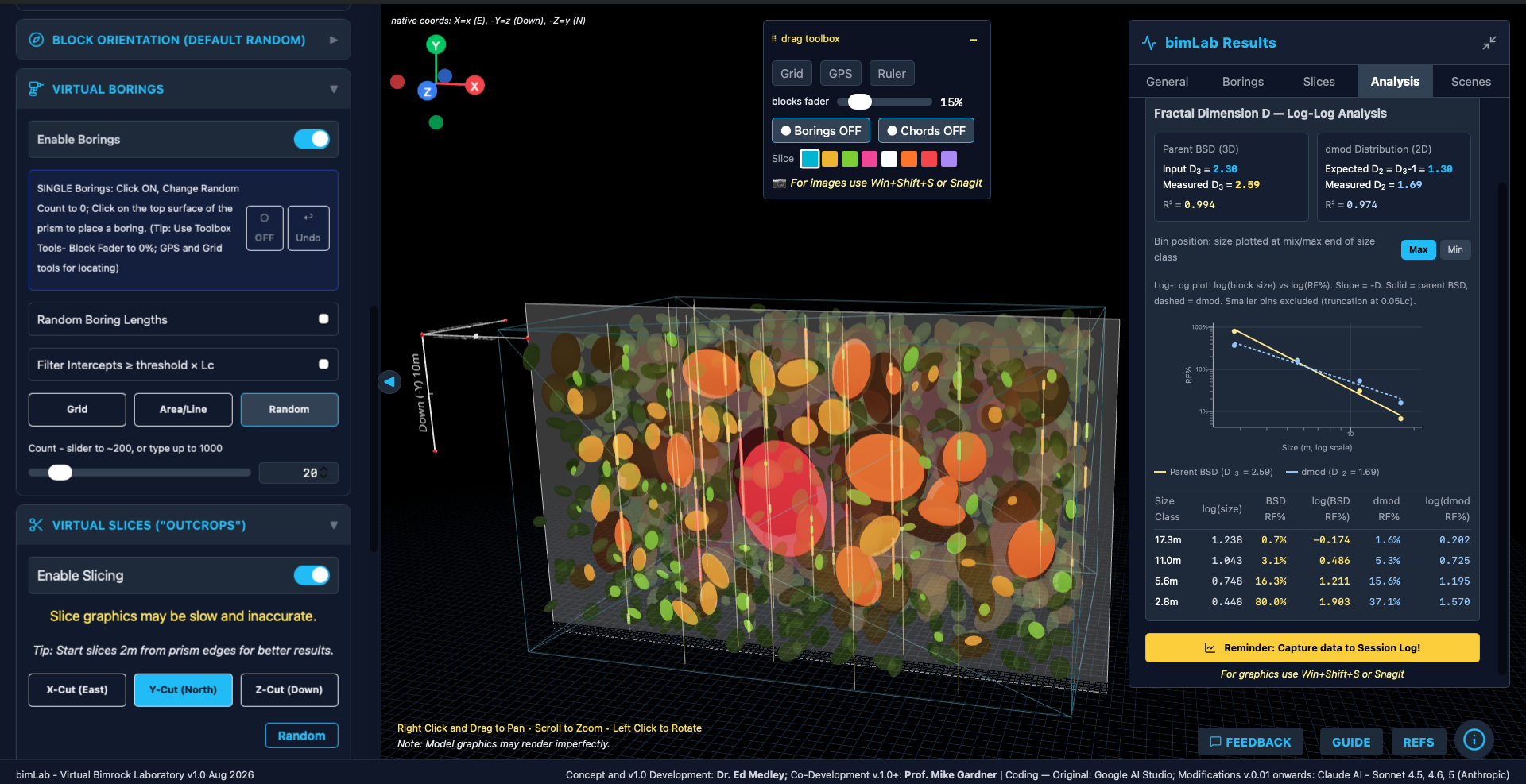
bimLab is a browser-based three-dimensional simulation environment for the investigation of block-in-matrix geomaterials—bimrocks, bimsoils, and soil-rock mixtures—in which competent blocks of variable size, morphology, and orientation are dispersed within a weaker matrix. The application encourages exploration of a fully characterized virtual three-dimensional rock mass with the same sampling methods used in field practice: one-dimensional borings and two-dimensional exposures (cuts and outcrops).
The app reveals the vast difference between in-situ bimrocks and the inadequate characterizations resulting from field exploration: the stereological gap. The app highlights the systematic disparity between block populations inferred from 1D and 2D observations and the true 3D Volumetric Block Proportions and size distributions—and to evaluate the extent to which such biases may be quantified and corrected. bimLab allows configurable block-size distributions, including fractal and power-law formulations, interactive boring and slice (outcrop) sampling arrays, and computes concurrent comparative statistical estimators and graphics.
bimLab was created by Dr. Ed Medley and developed in close collaboration with Prof. Michael Gardner. Dr. Medley’s longstanding contributions to the characterization of bimrocks and the stereological analysis of block-in-matrix materials underpin the scientific basis and the methodological approaches embodied in the tool. The software can be accessed at this link.